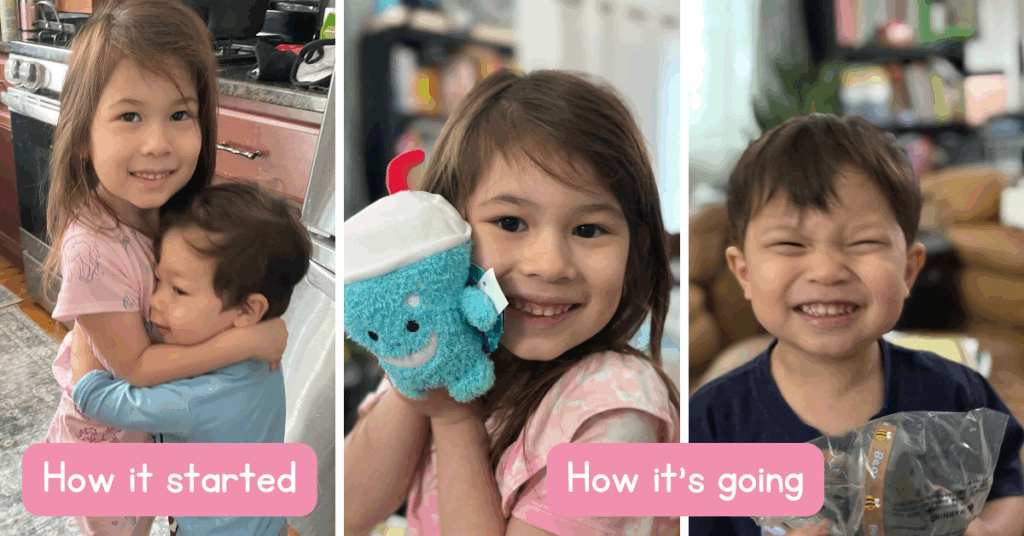
This year has been our third year of homeschooling and it was quite different from previous years. Although we do year-round homeschooling and will continue to do schoolwork over the summer, my daughter asked to be considered a first grader sooner so she’s unofficially there. We’ll continue reviewing her kindergarten materials and add in first grade math and other things as the summer progresses.
Here are the things that have remained consistent or that have changed from last year, but have become consistent:
- My daughter has a huge love of learning and still asks for homework, and now Girl Scouts, regularly.
- She has maintained interest in more things/resources this year than ever before.
- She has access to screens, but her creativity levels still just keep growing!
- My son wants to be included in everything we do in homeschooling.
- Our family craves adventure and visiting new places.
Here’s what homeschooling has looked like for year three (kindergarten for my daughter and some toddler learning opportunities for my son).
Catholic Heritage Curricula
This year we had the amazing opportunity to partner with Catholic Heritage Curricula (CHC) to review their kindergarten materials. My daughter learned a lot, but even more importantly for her age, she began to learn about God and Jesus and her faith. She loves being Catholic and doesn’t really understand why not everyone is a Catholic.
I’ll share about the other materials below, but I absolutely love their Catholic school books. Who Am I? Kindergarten Teacher’s Manual and Who Am I? Kindergarten Workbook are filled with topics that are important to our faith. I really like how it shares stories from the Bible in language that a kindergartener can easily understand. There are lesson explanations that simplify the concepts, application to make them more relatable, and review questions throughout to reinforce anything the kids hear. My daughter is usually good at answering the questions and asking some of her own. The workbook activities are fun and also reinforce the lessons – I usually make a copy of these and the review worksheets (in the back on the teacher’s manual) so that my toddler son can also “do” the worksheet… which usually means coloring the entire page or writing on it, but he loves being included.
Reading and Language Arts
Early this year we finished the last couple of Eric Carle books and activities in Rabbit Trails through Literature: Preschool. We also continued going through Reading Better Together. Although K knew her letters and their sounds, she had difficulty blending until she had progressed further in speech therapy – improved articulation really made a difference in her ability to learn to read!
Since she already knew her letters, Little Folks’ Letter Practice workbook from CHC was a great way to reinforce the letters and start to teach her to draw them correctly. There are some letters she still draws creatively every time, but the workbook helped most of her letters become much more recognizable. CHC’s Catholic Heritage Handwriting, Level K helped her understand spacing and reinforced the correct letter shapes. I love how many of the writing practice sheets mirror the stories in CHC’s Little Stories for Little Folks: Catholic Phonics Program. Not only was she continuing to work on handwriting and spacing between words, but she was also working on reading at the same time. The stories are simple but fun.
Reading was a challenge for a long time, but then K’s speech and language pathologist (SLP) suggested Bob Books. K literally went from guessing everything and making things up to actually reading. I think this was also at a time when she went from still being delayed in her articulation to making huge strides and starting to get ahead. At that point, she also went from taking 7 minutes to read a Bob Book to taking only 3 minutes. She was also able to enjoy the Little Stories for Little Folks and a variety of Level 1 readers from the library. As extra reinforcement, she has recently been having 1:1 tutoring for literacy at the library (she’s attended 3 sessions so far and loves it). K thrives when we use a variety of methods for learning, so each of these books and programs have contributed significantly to her improvement as a reader.
Note: for toddler language arts, O has letter puzzles and enjoys telling us all of the letters he sees, recognizing both capital and lowercase letters. He knows some of the associated sounds and loves to sing the alphabet song. He used to say “ah, ah, bopple!” instead of “apple,” but I think it was more to mess with us than anything lol. He says apple correctly these days.
Math
K used CHC’s Little Folks’ Number Practice workbook for part of her math curriculum this year. She was able to practice writing her numbers correctly and there was some math concept review included at the back of the book. K was so excited to finish this book and finally be in first grade. After she finished, we used The Good and The Beautiful’s Math Placement Test. She easily passed the Math K placement test, but the Math 1 test showed that she wasn’t ready for first grade math yet. Once I explained even and odd to her, she passed the Math 1 test also. Although we hadn’t focused heavily on math this year, she’s learned many of the concepts through general life schooling and natural curiosity. We also have (and have used) Brainquest books for each grade and the summers in between grades and Highlights books that have reviewed some of the concepts in fun ways.
Note: for toddler math, the main focus has been numbers and counting. O has number puzzles and enjoys randomly counting things that he sees or he does. He has often counted how many strawberries are in his bowl before eating them. For the longest time, he would miss the number 6 every time he counted, but counting with him has helped and he doesn’t usually miss it anymore. He also enjoys doing jigsaw puzzles.
Science
K has been learning science using CHC’s Behold & See K: Exploring Nature with Stories, Activities, and Nature Walks. It was a bit of a transition for her from thinking of science as only experiments to learning that all of nature is science. I think this is part of why Girl Scouts appeals to her so much. There is a big focus on STEM (science, technology, engineering, and math).
Alongside her Girl Scout badges that have included several nature and space science related badges, K joined a STEM Sisters program and did extra work in space science and chemistry. She also learned how to be a citizen scientist, planted seeds, and made seed bombs.
Note: for toddler science, O loves watching animal videos on YouTube Kids. He especially loves watching Fun Time with SoSo. O also joins K for most of her lessons and enjoys sensory bins.
History and Memories
Although we didn’t specifically focus too much on history, the religion books shared the history of our faith. We also worked about halfway through Bede’s History of ME. Since history wasn’t required for kindergarten in New York, it wasn’t a huge focus for us, but we did try to naturally integrate history into learning when it made sense. When we visited Pearl Harbor, K earned a Junior Ranger badge, and she also took the time to learn about World War II and earned Girl Scouts of Hawaii’s WWII Remembrance Patch. O was too young to do the Junior Ranger program, but he was there as we explored… until he fell asleep. While in Hawaii, K also earned the Queen Liliuokalani Patch from Girl Scouts of Hawaii by learning about Hawaii’s history and their last sovereign monarch.
Both kids have used memory keeper notebooks this year. For K, it mostly includes activities where I’ve written out questions from her various school books or Girl Scout badge workbooks for her to answer by writing or drawing a picture. We also glued in a lot of artwork and projects she’s done. For O, it’s the same notebook he had last year, so it’s filled with pages upon pages of him using crayons and markers to scribble. Both kids enjoy using dot markers and doing sticker-by-number pages, so we glue their artwork into the notebooks. I add dates to most of the work so we can see the progress. O loves it so much that he will immediately bring me his artwork to glue it in. I think he’s going to be surprised in a few months when he turns 3 years old and gets a new preschool notebook!
Character and More
K used CHC’s Building Good Character, Level B for part of the year. I think it will be easier to use when her brother is a little older. It felt unfair to try to tell her that she needed to work on certain things when she then had to ignore or overlook when her little brother did the opposite. I think it’ll be easier next year because he’s gotten much better at understanding things, learning, and communicating. CHC’s Rhyme-Time Collection Teaching Booklet and Art Prints was fun for K. She quickly memorized most of the poems and enjoyed trying her own versions of the artwork.
The kids had more arts and crafts time than in previous years. They both enjoyed using play-dough, dot markers, crayons, and colored pencils on a regular basis. We brought out paint several times, and they did sticker-by-number pages a few times each month. Sensory bins were a big hit, but they always made a mess. I’m looking forward to warmer, dry weather so we can take the sensory bins outside for easy cleanup! The kids got to go outside for physical activity more often because they both have gotten better at listening (for safety). They have a trampoline inside and have a “treehouse” with a slide and swings outside. We didn’t use many digital resources (aside from those mentioned) because the physical books covered most subjects well.
New York requires just a handful of subjects for homeschooling kindergarten: patriotism and citizenship; health education regarding alcohol, drug and tobacco misuse; highway safety and traffic regulations, including bicycle safety; fire and arson prevention and safety. We didn’t use any specific books for these topics but had lots of discussions when the topics naturally came up.
Adventures & Field Trips
Since our family loves adventure and cruising, we took our trip of a lifetime in November and December. It started with a cross-country train ride from the East to West coast, then a cruise to Hawaii and Mexico, then the cross-country train ride back East again. We often visited the libraries around where we live and started doing the Lowe’s and Home Depot kids workshops each month. Not exactly a field trip, but we also went to the local middle school for K’s speech therapy 1-2 times per week so we were out and about a lot more than previous years. The resource officers (police officers) were really nice to K, so she decided to donate cookies from her Girl Scout cookie booth to them. When we delivered the cookies, they also gave our entire family a tour of the police station. Plus the kids got to sit in a police vehicle and use the lights, siren, and megaphone.
Final Thoughts
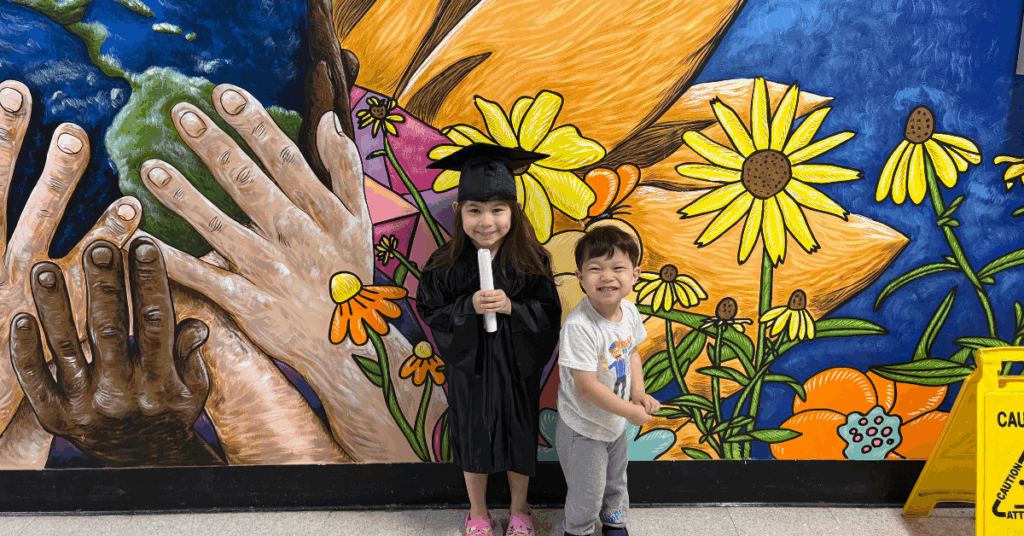
I’m so happy that I had the opportunity to partner with Catholic Homeschool Curricula for my daughter’s kindergarten curriculum. CHC Lesson Plans: Kindergarten made it so much easier to transition into a more intentional approach to homeschooling and allowed me to involve my 2 year old in many of the lessons. We are still working on consistency and figuring out a schedule (or a routine) that will work for us, but I’ve enjoyed what we’ve done this year and I know my kids have also. K had speech therapy sessions 1-2 times most weeks and had no sessions on other weeks this year because the school district follows a 6 day (A-F) schedule. She “graduated” from speech therapy in May and is no longer classified with a disability, so it should be easier to create a schedule/routine next year!
Beginning Girl Scouts in October was a great surprise! I’m not sure if my daughter will be gung-ho for the next 12 years, but she has been truly captivated with being a Girl Scout, earning badges and fun patches, and trying new things. This helped create new learning opportunities and made our vacation more educational. Girl Scouts has changed a lot since I was a kid and seems to be focused on STEM with girls earning many of the same badges at different levels. It means that this year has been filled with new things, but she may not be as interested in redoing the same things as a Brownie when she bridges to that level in another year.
Starting in first grade (this coming school year for K), New York has many more requirements: arithmetic, reading, spelling, writing, the English language, geography, United States history, science, health education, music, visual arts, and physical education. We’re also required to continue teaching patriotism and citizenship, health education regarding alcohol, drug and tobacco misuse, highway safety and traffic regulations, including bicycle safety, and fire and arson prevention and safety every year from kindergarten through twelfth grade. I’m still trying to figure out how we’ll be doing this, so I’ll share our curriculum choices in a future post.
Thanks for joining us today In Our Homeschool.
Disclosure: As an Amazon Associate I earn from qualifying purchases. This post may include affiliate links which means I may earn commissions for purchases made while using my link.