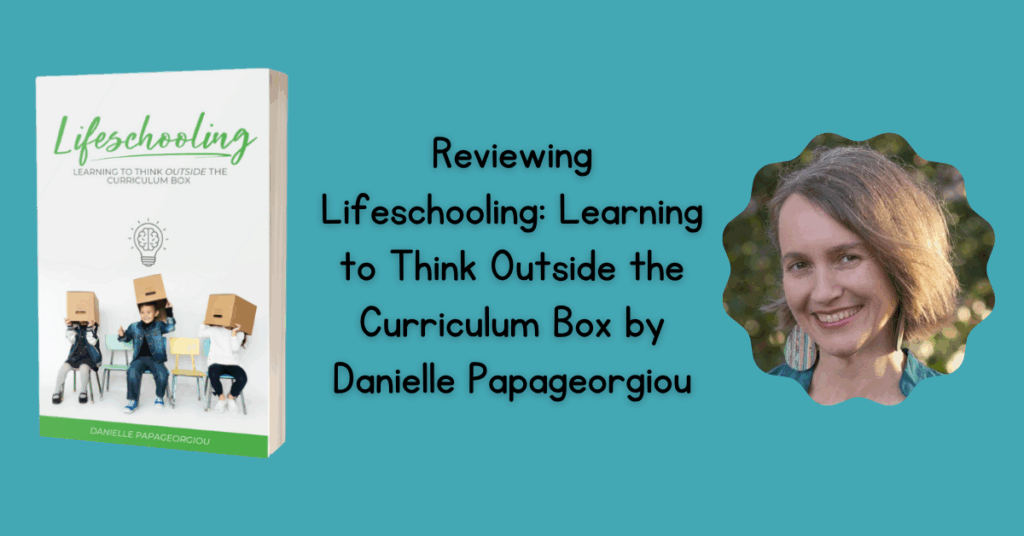
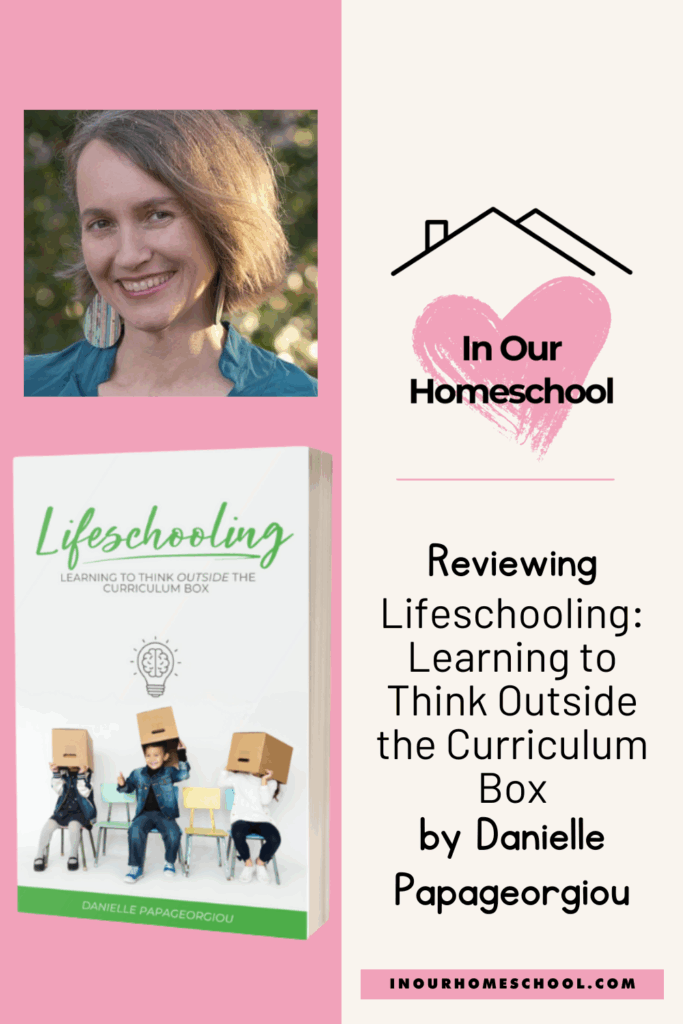
Have you ever heard of lifeschooling? As a relatively new homeschooler (yes, I’d call myself new to the game since this was my first year reporting), I’ve done research on a variety of homeschooling styles, but I had never heard that term until recently. I assumed it was a kind of unschooling. That’s not a bad guess, but I recently read Danielle Papageorgiou’s new book, Lifeschooling: Learning to Think Outside the Curriculum Box, and quickly learned how wrong I was. The following review and summary is based on information from her book.
Lifeschooling versus Unschooling
Unschooling is all about child-led learning. If your child has an interest, you can help them to follow it, but they’re the guide and they choose the topics you explore. If following unschooling to its core, the parent wouldn’t teach multiplication unless the child was interested in learning it. And if you found something that you thought would interest your child or an area where they’d likely excel based on their innate gifts, they could say they weren’t interested and, well, there goes that idea.
Lifeschooling is child-led, but also includes embracing God-given gifts. It focuses on the family’s needs over the individual child (as an example: a child might want to participate in a club that’s far away and they’d need rides, but the family has a homestead and can’t abandon their responsibilities for that long. Instead of following the wants of the child (a club is a want, not a need), the family needs would come first, but they would search for alternative solutions to still provide a similar experience to the child in a way the family could meet. Also at its core, unschooling does not use curriculum and emphasizes fun. Lifeschooling allows for the use of whatever helps the family learn/teach and emphasizes fun and fundamentals.
“Lifeschooling is the individualized process of discovering your child’s God-given gifts and talents, primarily through real-life experiences that happen within the context of your family’s unique situations and missions.” (Chapter 1)
The Four E’s of Lifeschooling
From Section 2:
Here is the basic rundown of the Four E’s of Lifeschooling:
• Exploration (playing and reading)
• Experience (everyday life, including chores, projects, field trips, travel, etc.)
• Expert Engagement (mentorships and apprenticeship opportunities)
• Entrepreneurship (learning how to use their gifts to serve in the marketplace)
Young children start by exploring the world. This is most often through play and through being read to and eventually reading to themselves. This is an opportunity for children to get their hands dirty exploring the world outdoors and to expand their minds exploring the world through books. Exploration is about exposure to all different things and a chance to begin to notice children’s interests and gifts.
Experience comes next. As you go about your days and make plans, determine if your children can be included or help. Try to find ways for them to learn while doing, like the math of doubling a recipe or estimating how long it will take to do something based on what they’ve done so far. You can also include your children in learning life skills, doing chores, and taking trips and traveling (we did this on our trip of a lifetime last year!)
Back before schooling became so formalized, most children would stop schooling by their teens and move on to mentorships or apprenticeships. That’s the idea of expert engagement. Children can learn directly from experts. Although the parents often provide mentorship, you may have friends or family in different fields that could teach them more, or perhaps have a local business willing to allow them to be an intern. There are also online resources that Danielle mentions in her book.
Entrepreneurship may be a lemonade stand, learning coding and providing coding services via Upwork or their own website, or, as in my brother’s case, selling Gatorade to his friends for a fraction of the cost (hey – it was all income to him… until my parents found out!). Not all children will enjoy entrepreneurship, but Danielle feels it’s worth exploring.
A Fascinating Idea
By all intents and purposes, Lifeschooling is a Christian homeschooling method that focuses on allowing God’s influence to guide your family, instead of regulations or standards. I believe that it can be a good choice for many families, but it is not the right choice for mine. Living in New York State, we have strict guidelines for the subjects we’re required to teach. Danielle addresses that point:
“If your state is restrictive, I would also propose that it might be worthwhile considering if you can move or lobby to change the laws. That might sound extreme, but let God lead your family.” (Chapter 10)
Moving isn’t feasible for my family, but I’m also currently fine with the subject requirements (ask me again in a few years, and that could change). I enjoy the idea of teaching a variety of subjects to further my children’s understanding of the world. Also, if I don’t teach my children biology or history or another subject, it could keep them from discovering their interests or God-given talents in fields that may not naturally come up in my household. Yes those topics will often be introduced in the Bible, but it’s not to the extent they would learn from a textbook and/or course.
That’s not to rule out this schooling method for others. Just because I don’t choose to follow the Charlotte Mason method in my homeschool doesn’t mean I feel that it’s wrong or bad. The same goes for Lifeschooling. It is another method to consider when homeschooling your children, especially for Christians who unschool. Danielle’s book, currently available to read in paperback and on Kindle Unlimited, is worth reading to see if the method is right for you.
Interview with Danielle Papageorgiou
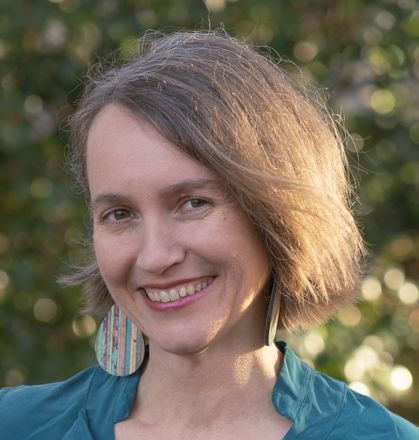
Can you share a little about yourself and what you do for my readers?
I’ve been married to Jon for 26 years and we have two homeschool graduates and a 13-year-old. We have been homeschooling, or “lifeschooling,” for 23 years and I have a passion for helping other moms learn how to homeschool in a way that enhances rather than competes with family life.
Through my Lifeschooling book, blog (www.LifeAsALifeschooler.com), resources, and community, I help you see the educational value in everyday life and focus on developing your child’s God-given gifts, so you can raise a world-changer.
What inspired you to write Lifeschooling: Learning to Think Outside the Curriculum Box?
I have always loved to write and have also been very passionate about the topic of Lifeschooling, so from the time I discovered this passion inside of me, I knew I wanted to write a book. However, it just never seemed to happen! Life continued to get in the way.
Then last year, after a period of unrelated prayer and fasting, I woke up very early on the last day. God seemed to show me clearly how to set up the book, and suddenly I just knew! He was calling me to finally write it.
Looking back, I can see through multiple confirmations that this was indeed His timing. There were so many divine appointments and perfectly ordained connections! But He also showed me from a practical standpoint why waiting was best.
My two oldest children are grown and married (or engaged). They love the Lord with all their hearts and are leading successful lives. Had I written the book earlier, the message would not have been as well-received because I didn’t have the personal stories and evidence to back up my claims.
Have you always followed the Lifeschooling method with your children? When did you find it most helpful?
We started off, like so many other homeschool moms, following a “traditional” school-at-home approach, but quickly learned that the school model does not fit well with everyday life in a home, particularly when you have health issues or other circumstances.
My husband struggles with his health and our children have had to help a lot with outdoor chores and other jobs, so taking a more relaxed approach has helped us not to feel stressed on days when other things must take priority for the sake of the family. Having the mindset that everyday life is education, and that we can also continue any formal academics throughout the year takes off the stress!
Personally, this method doesn’t feel right for my family, but I can see it being helpful for many others. What would you say to a family that may be new to homeschooling and still researching which methods to apply in their home?
Take your time, ask God to guide you, and check your motives. Many moms make homeschooling decisions based on fear, rather than on faith. Let love guide you because “perfect love casts out all fear.” If you are following a method of philosophy because you are afraid your kids might not get everything they need otherwise, or because you are afraid of doing something different, then that is a fearful motivation and no matter how good the philosophy, your homeschool will struggle.
Don’t be afraid, also, to experiment with different methods and philosophies. Often you have to combine different approaches depending on the child or your family needs. Give things a chance and be flexible! Remember, this is about your child’s future, so take their opinion and interests into account.
How can my readers connect with you online?
You can download a free sample of my book, Lifeschooling: Learning to Think Outside the Curriculum Box, at www.LifeschoolingBook.com and read my blog at www.LifeAsALifeschooler.com. We also have a Facebook community at https://www.facebook.com/groups/Lifeschooling.
Thank you so much for your time! And thanks for joining us In Our Homeschool!
Disclosure: As an Amazon Associate I earn from qualifying purchases. This post may include affiliate links which means I may earn commissions for purchases made while using my link.